Rituals as Meaning
You probably already have the raw material: the first coffee, the walk at lunch, the way you close the kitchen at night. Ritual research says the difference between a routine and an anchor is mostly attention plus structure. This page covers the lab evidence on what rituals do, the everyday rituals worth building, and how a routine becomes a purpose anchor without becoming a superstition.
What the evidence supports
- Performing a ritual before a stressful task reliably reduces anxiety and improves performance in experiments (Brooks et al., 2016).
- Rituals deepen enjoyment of ordinary experiences — eating, drinking, even small acts (Vohs et al., 2013).
- Rituals strengthen self-control during goal pursuit in both lab and field studies (Tian et al., 2018).
What remains uncertain
- Most experiments are one-shot and in the lab; how ritual effects hold up across months of daily life is understudied.
- Whether rituals add anything to a routine for long-term health outcomes has not been tested directly.
- Which rituals "take" for which people is individual — the research describes mechanisms, not a universal recipe.
Evidence last reviewed: August 15, 2026. Conclusions may change as new research is published.
What Makes a Ritual
The research definition separates ritual from routine on three features (Hobson et al., 2018, Personality and Social Psychology Review): repetition — it happens in a fixed form; rigidity — the steps matter and have an order; and symbolism — the act means something beyond the act. Brushing your teeth is a routine. The same two minutes, done in the same order, with the thought "this closes the day," is a ritual. The ingredients are cheap; the meaning is the one part you have to add yourself.
That last clause is why this page belongs in the Purpose pillar. The parent topic established that meaning is mostly daily and ordinary; rituals are the technology that attaches meaning to ordinary moments. A ritual is a small act of care, competence, or connection — the micro-purpose triad — performed at a fixed point so the day coheres around it.
The universality is itself evidence. The same review notes that rituals appear in every human culture studied, attached to the same life moments — meals, transitions, work, mourning — which suggests the function is built in, not fashionable. You are not adopting a wellness trend; you are reinstalling a feature of ordinary human life that modern schedules quietly deleted.
Product picks are generic categories, not brands. We may earn a commission on Amazon or iHerb purchases at no cost to you — this never changes our evidence conclusions. Full disclosure
Meditation cushion or supportive chair accessory
May make a meditation practice more physically comfortable.
⚠️ None expected; meditation can be difficult or unsettling for some people and is not a replacement for mental-health care.
Check price on Amazon →What the Lab Shows
Three findings carry the field. First, rituals reduce anxiety before performance: in a series of experiments, participants who performed a small ritual before singing, or before a math test, reported less anxiety and performed better than controls (Brooks et al., 2016, Organizational Behavior and Human Decision Processes). Second, rituals deepen experience: people who performed a ritual before eating chocolate or drinking lemonade enjoyed it more and rated it more interesting (Vohs et al., 2013, Psychological Science). Third, rituals support self-control: enacting a ritual before a goal-related task improved persistence and healthy choices in lab and field studies (Tian et al., 2018, JPSP).
The honest limits, stated plainly: these are small samples, short horizons, and mostly one-shot performances. The lab shows rituals change the felt quality of moments. Whether a lifetime of them changes health is inferred — through the stress-reduction and meaning channels the Downshift topic and this pillar document — not measured directly.
Everyday Rituals and What They Anchor
| Ritual | What it signals | Mechanism | Evidence |
|---|---|---|---|
| ☕ The morning coffee, done slowly | The day has a beginning | Transition marker; savoring | Consistent |
| 🚶 The daily walk, same route | Movement plus clearing | Mild activity; mental detachment | Consistent |
| 🍽️ The weekly shared meal | Belonging, on a schedule | Connection; collective ritual | Supportive |
| 🌙 The closing-the-day reset | Work is over | Boundary between roles | Supportive |
| 📅 The Sunday review | The week coheres | Reflection; planning | Early |
None of these requires new time — each is a routine you likely already run. The upgrade is the symbolism and the fixed form. The walk's health evidence lives in the Walking topic; this page's claim is narrower: the same walk, done as a ritual, also becomes a meaning anchor.
Simple visual timer
Can reduce friction for short breathing, mobility, or meditation breaks.
⚠️ None expected; it does not treat anxiety, panic, depression, or trauma-related symptoms.
Check price on Amazon →The Boundary Ritual
The most useful ritual in the research is the transition — the act that separates one state from another. In the experiments, rituals worked best when they marked a boundary: before a performance, between grief and normalcy (Norton & Gino, 2014), between work and home. The modern problem is that most boundaries have dissolved — the commute became a walk to the next room. Rebuilding a two-minute boundary ritual — a specific way you close the laptop, a route you walk, a sentence you say — reinstates the transition the environment no longer provides. The Downshift topic's daily-unplug ritual is the same device pointed at stress physiology.
Turning Routine Into Ritual
The conversion recipe is five steps, and the whole thing fits in a minute:
- 🏷️ Name it. "The first cup" — not "having coffee." Naming declares the act significant, which is the entire mechanism.
- ⏱️ Bound it. A fixed point and a fixed length — the walk is twenty minutes, not however long the phone allows.
- 🚪 Mark the edges. A start step and an end step — putting the phone in the drawer, hanging the leash. Boundaries are where rituals earn their keep.
- 🖐️ Add one sensory anchor. The warm mug, the sound of the door, the same chair. Senses anchor memory, which anchors meaning.
- 🧠 Do it with attention. The difference between routine and ritual is that you are present for it — the same point the Meditation protocol makes about informal practice.
Install one at a time, attached to an existing routine, per the Habit Formation protocol's bundling logic. A ritual with no routine behind it is a resolution; a routine with a ritual on top is an anchor.
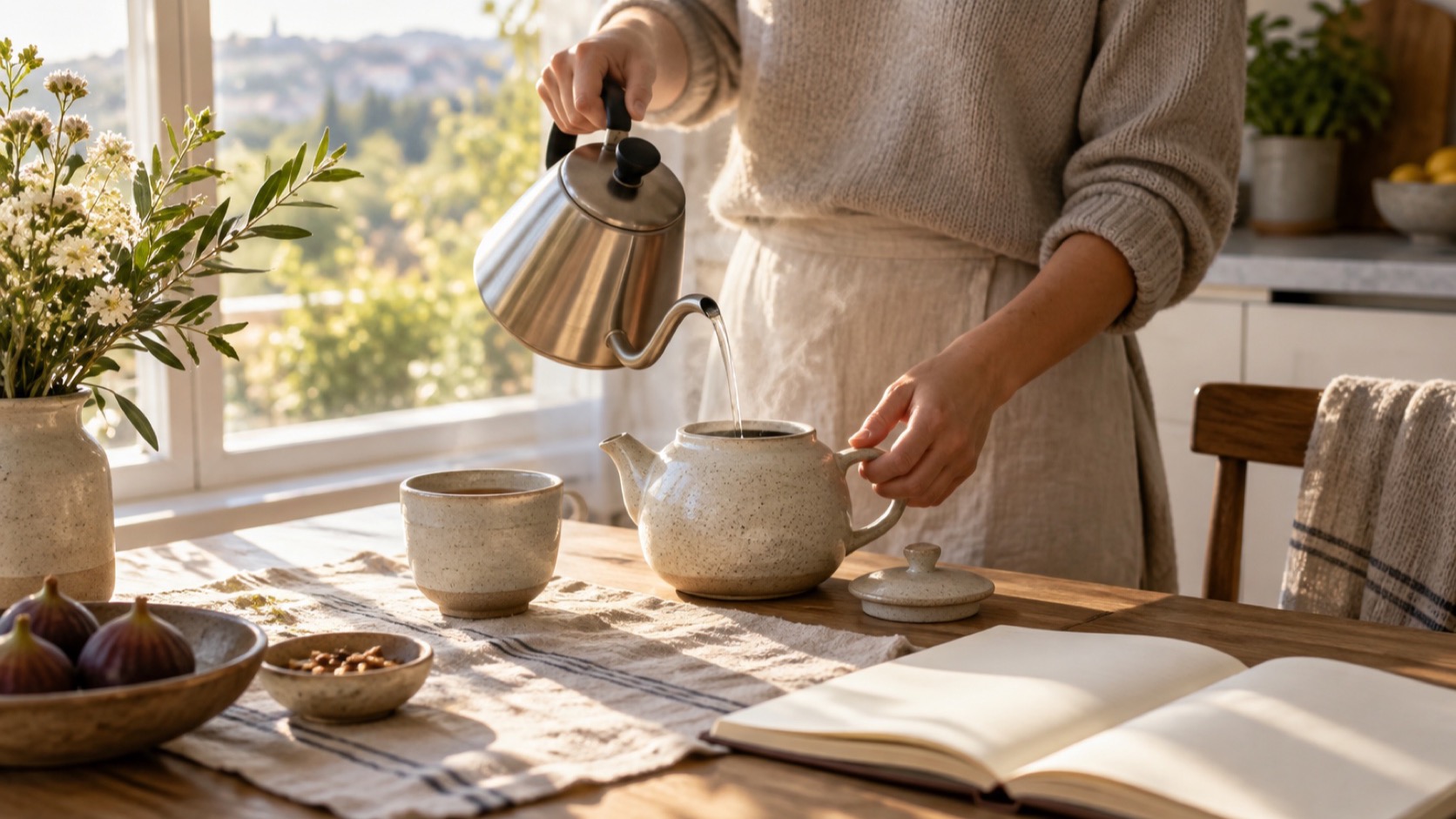
☕ The coffee is already a ritual
If you are reading this holding a morning drink, you are holding proof of concept. The research does not ask you to invent ceremonies; it asks you to notice the ones you already perform — the first cup, the same seat, the two minutes before the phone — and to stop treating them as background. Adding one deliberate feature to an existing act: that is the entire ritual technology, and it is why the evidence is so easy to put to work.
When Rituals Go Stiff
The caution is symmetry: the rigidity that gives a ritual its power is the same property that turns it into a liability. Three signs you have drifted from anchor to obligation: missing it causes real distress rather than mild disappointment; you keep the form while the meaning drains out; or the ritual starts dictating the day instead of serving it. The fix is usually to loosen the rigidity — keep the symbolism, allow the schedule to breathe. A ritual that cannot survive a disrupted Tuesday is not an anchor, it is a chain, and the stress it produces works against everything this pillar argues for. If rigidity is spilling into other areas of life, the Stress pitfalls topic covers when structure stops helping.
Questions, Answered Briefly
- 🤔 Is a ritual just a habit with feelings? Close — a habit is automatic, a ritual is deliberate. The research draws the line at symbolism: habits you do without noticing, rituals you do with noticing, which is where the meaning comes from.
- ⏳ How long until a ritual sticks? The lab effects are immediate (one performance), but a daily ritual taking root is a habit-formation question — weeks, not days, and the Habit Formation protocol owns the timeline evidence.
- 🙏 Does it need to be spiritual? No. The secular versions work in the experiments; the Religion & Spirituality topic covers the communal and transcendent forms if you want them.
- 🔁 Do rituals replace hobbies? They complement — rituals anchor the day, while the Hobbies & Habits topic's crafts and skills supply the competence source of meaning.
- 🧭 Which one ritual first? The boundary you are missing most. For most people that is the work-to-home transition — build that one, then let the rest follow.
The Bottom Line
- A ritual is a routine plus attention and symbolism — the ingredients are cheap, and you already perform the raw material daily.
- The lab shows real effects — less anxiety before performance, deeper enjoyment, better self-control in the moment.
- The health case is inferred, not measured — rituals earn their longevity claim through the stress and meaning channels, not through ritual-specific trials.
- Build the boundaries first — a beginning ritual and an ending ritual, one deliberate feature each, attached to what you already do.
Related Topics
- Hobson, Schroeder, Risen, Xygalatas & Inzlicht, "The psychology of rituals: An integrative review and process-based framework," Personality and Social Psychology Review (2018)
- Brooks, Schroeder, Risen, Gino, Galinsky, Norton & Schweitzer, "Don't stop believing: Rituals improve performance by decreasing anxiety," Organizational Behavior and Human Decision Processes (2016)
- Vohs, Wang, Gino & Norton, "Rituals enhance consumption," Psychological Science (2013)
- Tian et al., "Enacting rituals to improve self-control," Journal of Personality and Social Psychology (2018)
- Norton & Gino, "Rituals alleviate grieving for loved ones, lovers, and lotteries," Journal of Experimental Psychology: General (2014)
- Gino & Norton, "Why rituals work," Scientific American (2013)