Grip as a Longevity Biomarker
Of all the cheap measurements in preventive medicine, grip strength has the strangest résumé: a squeeze of the hand predicts who dies. This page walks the cohort evidence behind that claim — chiefly the PURE study's 140,000 adults in 17 countries — and is honest about what the association can and cannot tell you about your own future.
What the evidence supports
- Each 5 kg lower grip strength carried roughly a 16% higher all-cause mortality hazard in the PURE study (Leong et al., The Lancet, 2015).
- Grip predicted death more strongly than systolic blood pressure did, in the same PURE analysis.
- The association replicates in very different populations: half a million UK Biobank participants, older disabled women, and middle-aged men followed for decades.
What remains uncertain
- These are associations — whether deliberately strengthening grip itself adds years has not been shown in trials.
- Grip may partly stand in for overall health and body size rather than acting as an independent cause.
- Exactly how much of the signal is muscle quality, neurological integrity, or lifestyle confounders remains unsettled.
Evidence last reviewed: August 15, 2026. Conclusions may change as new research is published.
Product picks are generic categories, not brands. We may earn a commission on Amazon or iHerb purchases at no cost to you — this never changes our evidence conclusions. Full disclosure
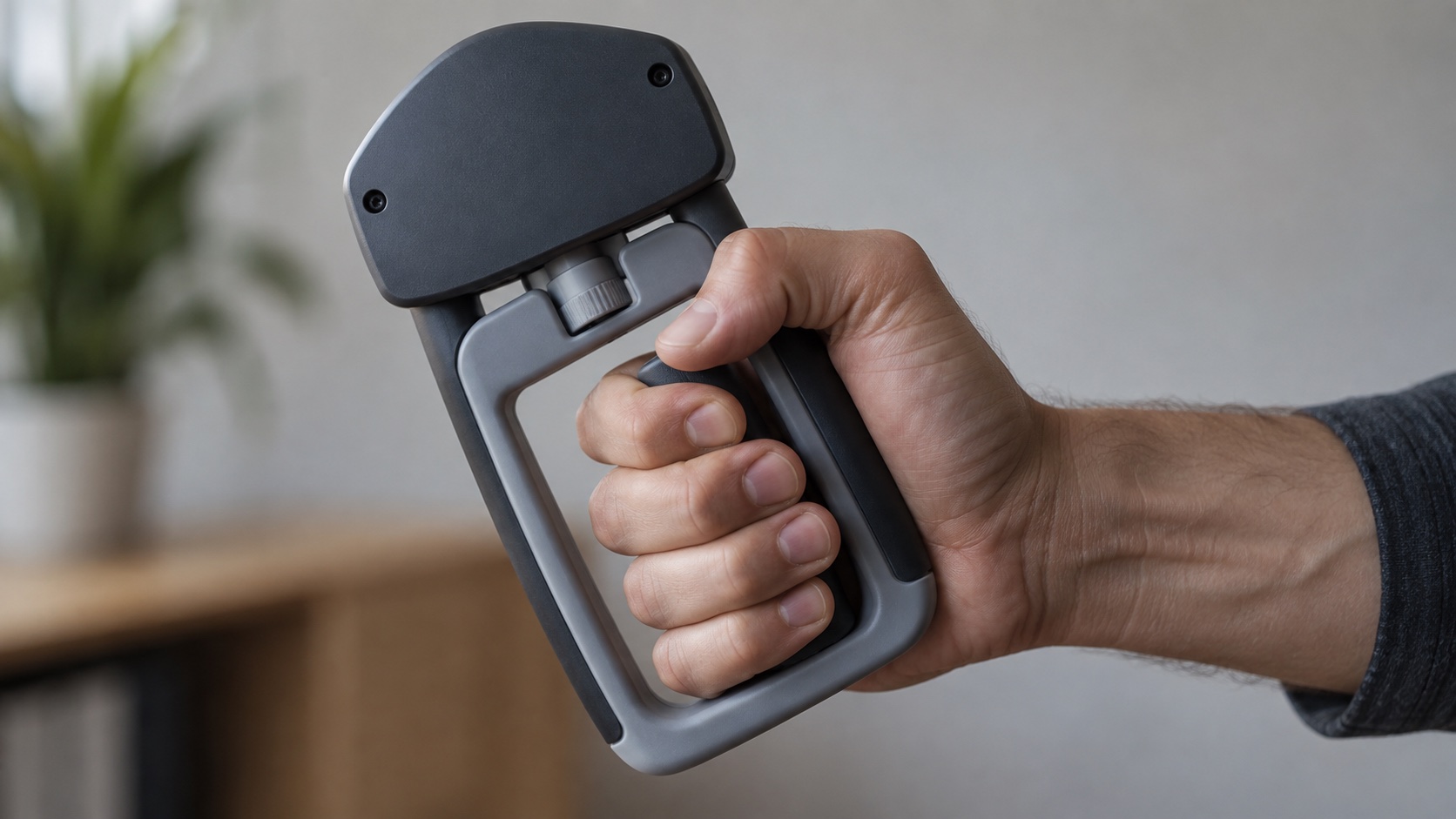
Hand-grip dynamometer
Can track grip-strength performance over time when measured consistently.
⚠️ Readings can be affected by pain, arthritis, technique, and device variation; a result is not a diagnosis.
Check price on Amazon →The Study That Made the Handshake Famous
The Prospective Urban Rural Epidemiology study — PURE for short — was designed to answer a different question: how do cardiovascular risk factors behave outside the wealthy, mostly Western populations that dominated the research literature? Between 2003 and 2009 it enrolled roughly 140,000 adults aged 35–70 from 17 countries spanning four income brackets, measuring them in cities and villages alike. Grip strength, taken with a Jamar dynamometer, was one item in a long battery — nobody expected the hand to be the headline.
It was. In the 2015 Lancet analysis led by Leong and colleagues, grip strength was inversely associated with all-cause mortality, cardiovascular mortality, and cardiovascular disease itself, with a consistency that held across income levels and across the countries studied. The dose-response was linear: every 5 kg lower grip meant a roughly 16% higher hazard of death from any cause. And in the comparison that made clinicians sit up, grip strength predicted all-cause and cardiovascular mortality more strongly than systolic blood pressure — the measurement every doctor in every country already takes. A dynamometer, the authors noted, costs a fraction of a blood-pressure cuff and requires no training to use. The grip–mortality gradient held in men and women, across income levels and countries alike — a consistency few single measurements in medicine can match.
How Much Risk Per 5 Kilograms?
The PURE numbers are worth seeing in full, because the pattern — strongest for cardiovascular death, weaker for the acute events themselves — is itself informative. Grip tracks the slow processes that set up heart attacks and strokes (metabolic health, frailty, inflammation) more than it predicts the acute events' timing.
The Replication Pile
A single striking result can be a fluke; a stack of independent replications is a signal. Grip strength has one of the deepest replication piles in epidemiology:
| Cohort | People followed | Headline finding |
|---|---|---|
| 🌍 PURE (Leong et al., Lancet 2015) | ~140,000 adults, 17 countries | 16% higher all-cause mortality per 5 kg lower grip; out-predicted systolic blood pressure |
| 🇬🇧 UK Biobank (Celis-Morales et al., BMJ 2018) | ~500,000 adults, ages 40–69 | Grip inversely associated with all-cause, cardiovascular, and respiratory mortality across every age and sex group studied |
| 🇺🇸 Honolulu Heart Program (Rantanen et al., JAMA 1999) | ~6,000 Japanese-American men, ~25 years | Midlife grip predicted who would be disabled in old age — a quarter-century warning |
| 👩 Older disabled women (Rantanen et al., JAGS 2003) | ~900 women followed 5 years | Grip predicted total and cause-specific mortality even among already-frail women |
The Honolulu result deserves special note because it closes a loop: grip measured at midlife predicted disability twenty-five years later. That is not a frail 80-year-old being flagged at the end of life; it is a 45-year-old's handshake containing information about their 70-year-old function. Whether the grip itself did the predicting or simply marked a body on a better trajectory is the question the mechanism section tackles next.
Adjustable dumbbells
Allows progressive loading at home across common strength movements.
⚠️ Poor technique or rapid load increases raise injury risk; not required to begin moving more.
Check price on Amazon →Why a Handshake Predicts Death
Nobody believes the forearm is the organ of longevity. Grip earns its predictive power as a proxy — one number that bundles several processes that matter:
- 💪 Total muscle mass: grip tracks whole-body lean mass closely enough that it is used to screen for sarcopenia. Muscle is metabolic machinery — a glucose sink, a protein reserve, and the structural insurance covered in the strength topic.
- 🧠 Neuromuscular integrity: a strong squeeze requires intact motor neurons, nerve conduction, and central drive. Grip partly measures the wiring, not just the motor.
- 🩸 Metabolic load: weak grip correlates with insulin resistance and type 2 diabetes risk — the insulin resistance topic owns that story — and with inflammatory markers in several cohorts.
- 🏃 Behavior, compressed: grip rises with training and manual activity, so part of the signal is simply a lifetime of movement summarized in one squeeze.
There is also a quality-versus-quantity subtlety worth naming. Two people with the same forearm circumference can grip very differently, because grip reflects not just muscle mass but how completely the nervous system recruits it. Ageing degrades both, and grip captures the combination — which is part of why it predicts more reliably than simple size measures in several cohorts.
That last point is the honest one. Grip is a mirror: it reflects muscle, metabolism, nerve function, and habits without you having to measure any of them directly. A mirror is not the thing it reflects, and a biomarker is not automatically a target.
✊ A mirror, not a lever
The evidence shows grip predicts outcomes; it does not show that squeezing a gripper adds years. The sensible reading: grip is the cheapest window into the systems that matter — muscle, metabolism, nerve function — and those systems respond to real training. Resistance training raises grip as a side effect of building the whole machine.
Is Grip a Real Biomarker of Ageing?
Sayer and Kirkwood asked exactly this question in a 2015 Age and Ageing commentary, and their checklist is a useful discipline. A biomarker of ageing should track age, predict outcomes, and reflect underlying biology rather than one organ's health. Grip clears the first two easily: it follows a life-course arc that the norms page maps, and it predicts mortality across continents. On the third it is weaker — grip is a composite, and composites predict well precisely because they average many signals. Bohannon's 2019 review (Clinical Interventions in Aging) made the practical case that matters for this site: grip is measurable in seconds, reproducible, and trainable, which are the properties you want in a marker you actually track at home. Whether it deserves the formal title "biomarker of ageing" matters less than whether it changes what you do — and a number that falls while you watch is a number that starts conversations. Serial measurement is also where home tracking beats epidemiology: a quarterly series from the same hand on the same device is a richer object than the single readings most cohorts can afford, and it converts a population statistic into a personal one.
Questions, Answered Briefly
- 🖐️ Does a strong grip add years? We do not know that the grip itself is causal. What we know: grip tracks the systems that trials show do respond to training, and trained people score higher. Treat it as a dashboard gauge, not an engine.
- 🏥 Should my doctor be measuring grip? Geriatricians and sarcopenia clinics already do. In primary care it is less standard, but a dated series of your own quarterly numbers is something any clinician can use.
- ⚖️ Is it confounded by body size? Partly — bigger people grip harder, and analysts adjust for it. The associations survive adjustment, which is why the signal is taken seriously rather than dismissed as size in disguise.
- 📅 How often should I measure? Quarterly is enough. The biomarker literature works with single measurements; your advantage as a self-tester is the trend, which a single clinic visit can never see.
- 🧓 I am 70 and above the median — am I done? Above-median grip at 70 is genuinely reassuring, but the habit that built it still matters: the same training protects bone, balance, and glucose handling whether or not the gauge moves.
- 🏗️ Does grip predict outcomes besides death? Yes — grip correlates with future disability, falls, fractures, and longer hospital stays in older cohorts, which is why surgical teams sometimes measure it pre-operatively. Mortality is simply the endpoint with the largest datasets.
The Bottom Line
- Grip strength is one of the best-replicated predictors of mortality in epidemiology — PURE's 17-country finding leads a long list.
- Each 5 kg lower grip carried ~16% higher all-cause mortality hazard, and grip out-predicted systolic blood pressure in the same dataset.
- Midlife grip predicts late-life disability — the Honolulu cohort saw a quarter-century ahead.
- The mechanism is proxy, not magic: grip bundles muscle, nerve function, metabolism, and habits into one number — which is why it predicts, and why training the whole body is the response.
Related Topics
- Leong et al., "Prognostic value of grip strength: findings from the Prospective Urban Rural Epidemiology (PURE) study," The Lancet (2015)
- Celis-Morales et al., "Associations of grip strength with cardiovascular, respiratory, and cancer outcomes and all cause mortality: prospective cohort study of half a million UK Biobank participants," BMJ (2018)
- Rantanen et al., "Midlife hand grip strength as a predictor of old age disability," JAMA (1999)
- Rantanen et al., "Handgrip strength and cause-specific and total mortality in older disabled women: exploring the mechanism," Journal of the American Geriatrics Society (2003)
- Sayer & Kirkwood, "Grip strength and mortality: a biomarker of ageing?" Age and Ageing (2015)
- Bohannon, "Grip strength: an indispensable biomarker for older adults," Clinical Interventions in Aging (2019)